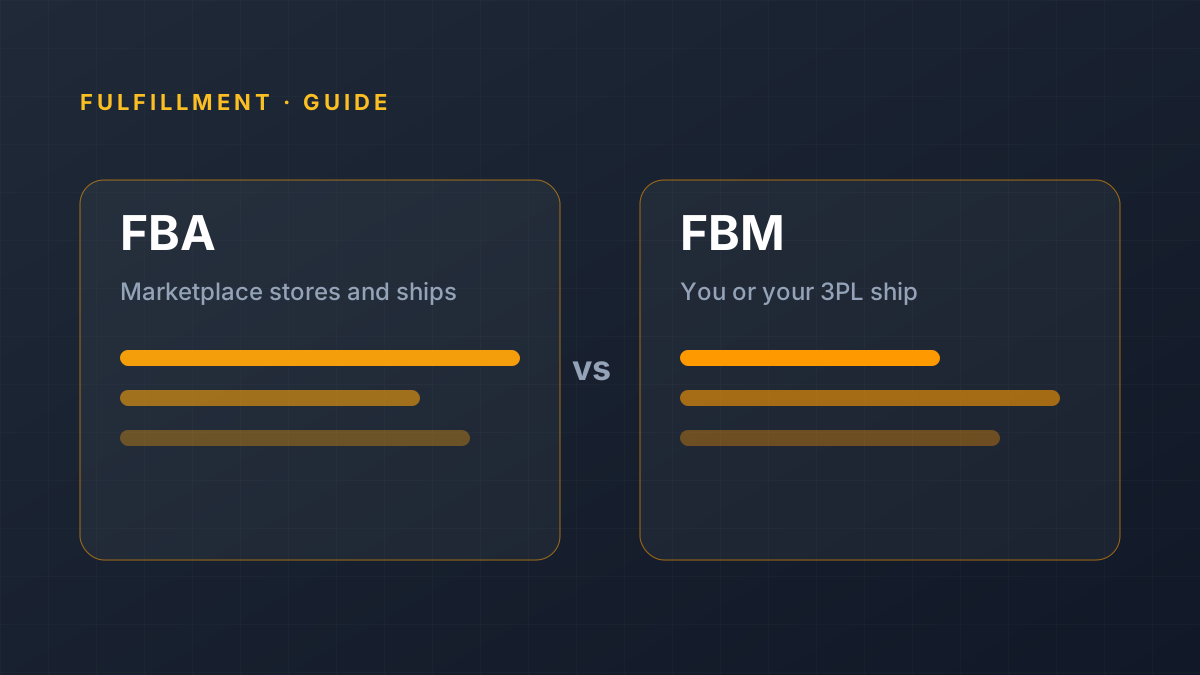
Fulfillment by Amazon (FBA) means Amazon stores, picks, packs and ships your products. Fulfilled by Merchant (FBM) means you or your logistics partner do it. Most guides treat this as a store-wide choice. In practice, the better question is which method suits each product.
Side-by-side comparison
| Factor | FBA | FBM |
|---|---|---|
| Who ships | Amazon | You or your 3PL |
| Prime badge | Yes, for eligible items | Only via Seller Fulfilled Prime, where eligible |
| Fees | Fulfillment and storage fees | Your own shipping and warehouse costs |
| Customer service on orders | Largely handled by Amazon | Your responsibility |
| Control over packaging | Limited | Full |
| Main risk | Storage fees, capacity limits | Shipping performance metrics |
When FBA tends to fit
- Small and standard-size products that sell steadily.
- Products where fast delivery strongly affects conversion.
- Sellers without their own warehouse or reliable shipping team.
When FBM tends to fit
- Oversized or heavy items where FBA fees are high.
- Slow-moving products that would build up storage fees.
- Custom, fragile or made-to-order goods that need special handling.
The hybrid approach
Many stores use both. A common setup keeps fast movers in FBA and uses FBM as backup when FBA stock runs low or inbound shipments are delayed. This needs clear inventory tracking so you do not oversell.
A simple decision checklist
- Calculate the fully loaded cost per unit for both methods, including storage.
- Estimate how many days of stock you typically hold.
- Check whether delivery speed changes conversion for this product.
- Confirm your own operation can meet FBM shipping metrics before relying on it.
Frequently asked questions
Can I switch a product between FBA and FBM?
Yes. You can change the fulfillment channel of an offer, or run both as separate offers.
Is FBM riskier for account health?
FBM adds shipping metrics you are directly responsible for, so it needs a reliable process. With one in place, it is a normal and widely used model.